

I love our school. The environment is great. The people are positive and it’s a joy to work with them. The school philosophy is largely based on mutual respect. This is not just a philosophy. You can see it being put into practice every day. We listen to each other and take each other’s ideas seriously. This includes not only faculty and staff but also students. The kids have a legitimate voice and are empowered to make change both within and outside the school. They are given freedom and are expected to use that freedom wisely. The same goes for faculty and staff. Employees are relatively autonomous and supported. If someone wants to start a new program or initiative, then they are taken seriously, and the school is usually supportive of that idea.
The school does an exceptional job of supporting creativity and individuality. I’ve never seen a school environment where kids feel so free to be themselves and where they encourage their fellow students so well.
This supportive environment also makes it ok to try and fail. Students and employees are respected and if they are giving their best effort that is rewarded. I have not always worked in an environment like this, so I really appreciate it.
Personally, I have a good relationship with failure (see my infographic on this below). Most of the time I genuinely appreciate the lessons learned and the opportunity for growth. When I persevere and succeed after encountering failure, I feel like I’m better equipped to deal with the next challenge. I don’t always like failure or see the value of it when it’s happening. It’s certainly more comfortable when I don’t fail. But I usually realize at some point that the growth opportunities and feeling of accomplishment that comes from succeeding after facing and overcoming obstacles are much greater. I’m happy to work in an environment that supports our students when they go through this same process.
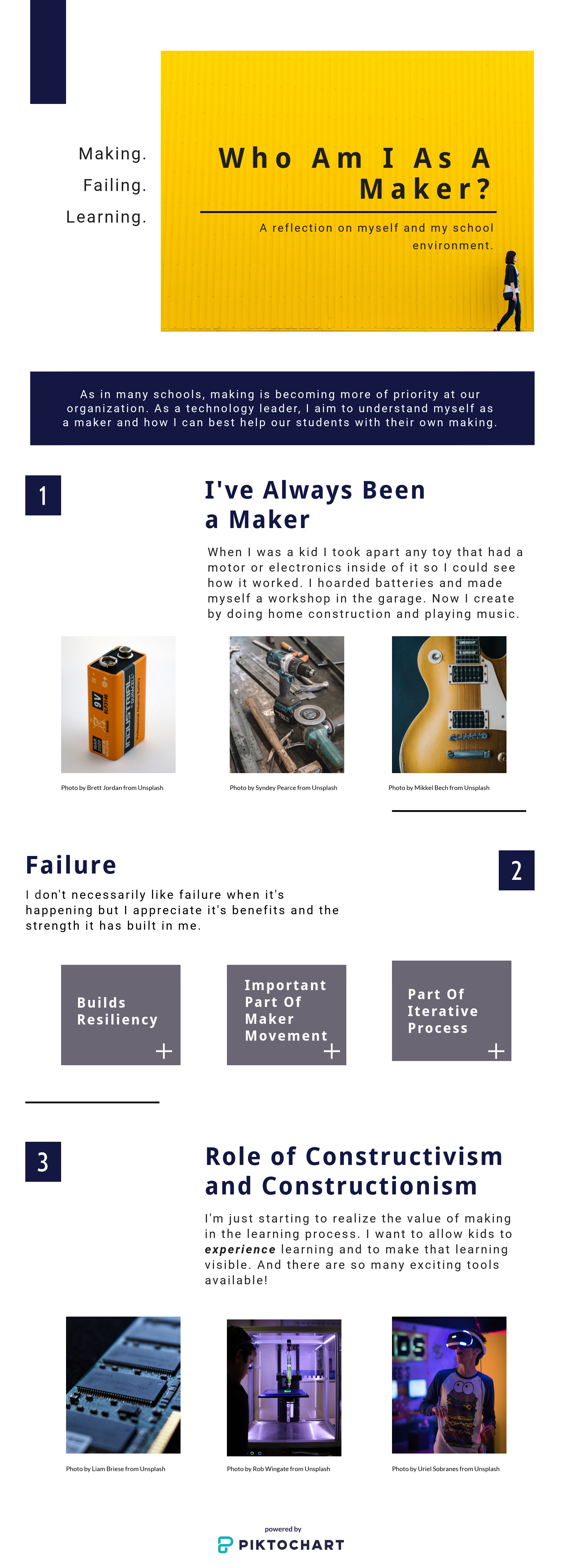
A relationship with failure like we have at our school is especially important as we look at increasing STEAM implementation into our curriculum and as we implement a new makerspace in the future. To get the most out of a makerspace, students need to have the freedom to create and not have a prescription to follow. An iterative design process becomes important in the process (Martinez, Stager p. 51). Since there is no recipe to follow it’s possible that creations will not work as expected after the first try. It is often necessary to refine or redesign the project multiple times.
This ability to reiterate and to see “failure” as one more step in finding a solution aligns closely with one of our school’s core tenets, namely to “prepare this future generation to deal with the unknown.” In the iterative process, students are practicing solving a problem without having a series of steps or formulas to follow. They are required to find their own solutions. When they do this “creativity, collaboration, and a degree of student agency over the process play an essential
role.” (Cohen, Jones, Smith p. 36)
Our school values technical innovation, but we do not adequately support it. People share their ideas regarding technology in the classroom readily. Many teachers want to implement technological innovations but don’t feel like they have enough time to play with new technologies. We also provide very little professional development for educational technology.
Fortunately, we realize that this is a problem and we want to support our teachers. We are currently working with a scheduling consultant to rethink how we can schedule our days. One of my goals in this process was to advocate for time for teachers to learn new technologies and to provide meaningful professional development. We are also working on figuring out how to provide technology implementation specialists in the classroom.
Some teachers are doing innovative projects despite the constraints like using arduinos to control lights on dance costumes or using 3d printers to solve real-world problems. The desire is there. We just need to make sure the faculty has the tools and support they need.
References
Cohen, J. D., Jones, W. M., & Smith, S. (2018). Preservice and Early Career Teachers’ Preconceptions and Misconceptions About Making in Education. Journal of Digital Learning in Teacher Education, p. 32. Retrieved from https://d2l.msu.edu/content/enforced/663255-SS19-CEP-811-733-97KUFY-EL-14-204/Cohen%2c%20Jones%2c%20Smith%20(2018).pdf?_&d2lSessionVal=Nn82jwky4DuqCXFRg9VlMUBOq&ou=663255
Martinez, S. L., & Stager, G. (2019). Invent to learn: Making, tinkering, and engineering in the classroom (2nd Edition), p. 51. Torrance, CA: Constructing Modern Knowledge Press
 Brian Durst EdTech