
Questions have sometimes been frustrating for me. I have been in meetings where people are just asking questions and not proposing any practical ideas of how to actually get anything done. It seemed merely philosophical as if they were just thinking out loud rather than doing the work of trying to solve problems. After reading “A More Beautiful Question” by Warren Berger (2014) my perspective has changed a bit. I still believe we need to accomplish something practical in most meetings, but I now think the right questions have the potential to help us think more deeply about our issues and to create a mindset more favorable to innovation.
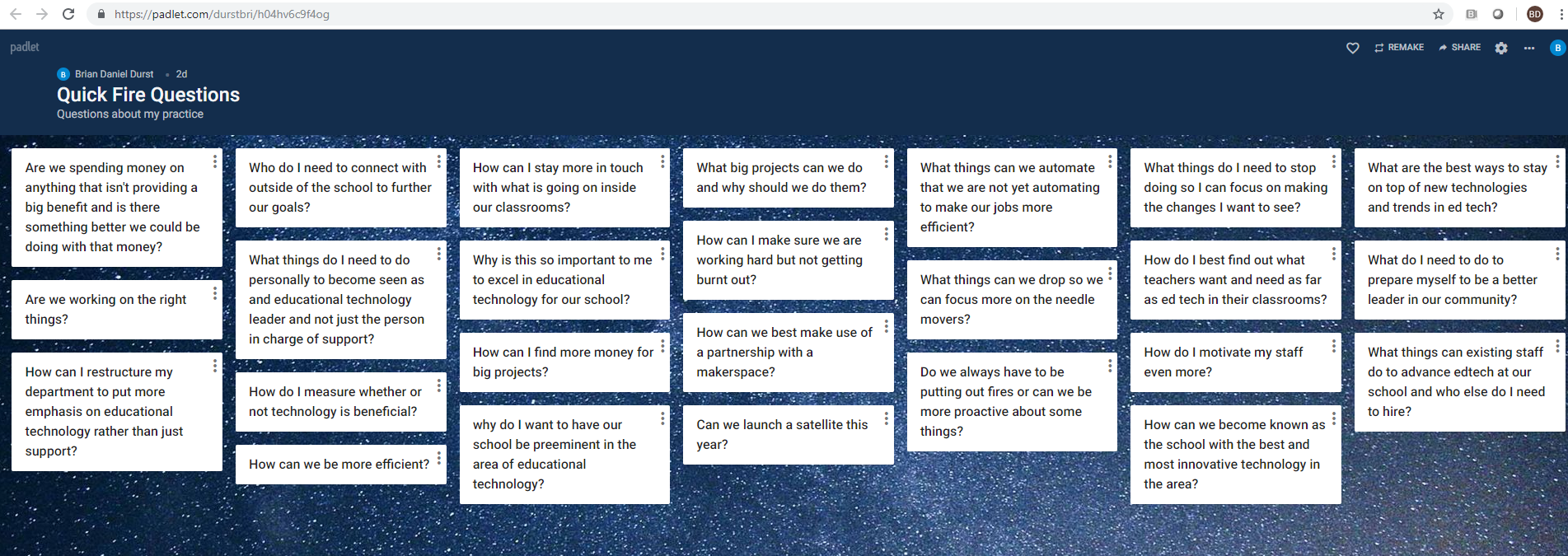
To experiment with this idea, I did a five-minute “quickfire” brainstorming session to create questions that might help us improve our technology environment. I thought it would be difficult to think of more than a question or two. I had no questions in mind going into the session, so five minutes seemed like a long time. I found that after I thought of the first question though the ideas kept flowing and I didn’t want to stop when my timer went off, so I kept going. In order to maintain flow, I was conscious not to edit my questions. It seemed more natural to let the ideas flow when I formed them in questions rather than statements. Formulating questions created a sense of curiosity about the things I was thinking about, which encouraged me to look for more ideas.
I used Padlet to create a virtual index card for each question. I had thought of Padlet as a tool to be used to encourage engagement and get student or audience feedback in the classroom or during presentations. I did like using it as a brainstorming tool though, and I’d like to experiment with it more in a group session.
So why does questioning matter? One of our school’s core tenets is “To prepare this future generation to deal with the unknown.” Berger (2014) said that workers must learn new skills constantly and that they are “often left to figure out for themselves what new skills will make them more valuable or just keep them from obsolescence.” (2014, p. 20). He said that in the past, we would figure out what our job was and then keep repeating that same work again and again. Things are changing so fast now and with so much complexity that workers continuously need to learn and to figure out what they need to learn (2014). If we are going to prepare our students, we need to teach them to question and to continue learning.
Children show increased creativity and curiosity if we allow them to come up with their own questions and to search for answers to those questions but when teachers are pushed to stick to mandated guidelines, “it can cause them to be less receptive to students’ ideas or inquiries.” (Berger, 2014, p. 47). Questioning also dramatically drops off when students start grade school (Berger, 2014). Are we depriving our students of a valuable skill by mandating what teachers must teach? What can we do to encourage questioning?
I feel fortunate to work at a private school where we aren’t required to teach to specific content standards. In faculty orientation, teachers are made aware that kids will sometimes ask questions that we won’t be able to answer right away. Teachers are encouraged to adopt the attitude of “That’s a great question! I don’t know the answer, but how about we find out together?” I believe this willingness to release the role of the “sage on the stage” and to be a participant in learning right alongside the student encourages questioning and is a great way to model it.
I would like to emphasize the same attitude even more in our technology integration and curriculum. Teaching basic coding is important, but instead of stopping there, we need to keep asking what can we do with this knowledge. Why is it important? What can we do with technology and what experiences can we have that we wouldn’t otherwise be able to?
References
Berger, W. (2014). A more beautiful question: The power of inquiry to spark breakthrough ideas. New York, NY: Bloomsbury.
 Brian Durst EdTech