
Last week I wrote a blog post about how we are working on getting our students access to a makerspace to provide them with new 21st-century learning experiences and to increase their exposure to technology. I sent a survey about this to 56 people, and 20 of those have responded so far. Most of them are experienced teachers from our school community, although many administrators responded as well.
I was surprised to see that over half of the respondents would be willing to give up existing computer labs and carts if doing so meant more money and support could be provided to a makerspace. I did not expect our community to be so willing to part with these resources. We need to investigate further, but I believe as we move towards a formal BYOD program, we could eliminate some of these resources at the Middle/Upper school. Doing so could give us significant funding to purchase a base set of equipment for our makerspace.

I’m excited to get a makerspace working, and I expected to see that same excitement in the survey results, but that was not the case. On average, survey-takers rated themselves at 3.32 out of 5 when asked how motivated they were to use the makerspace.
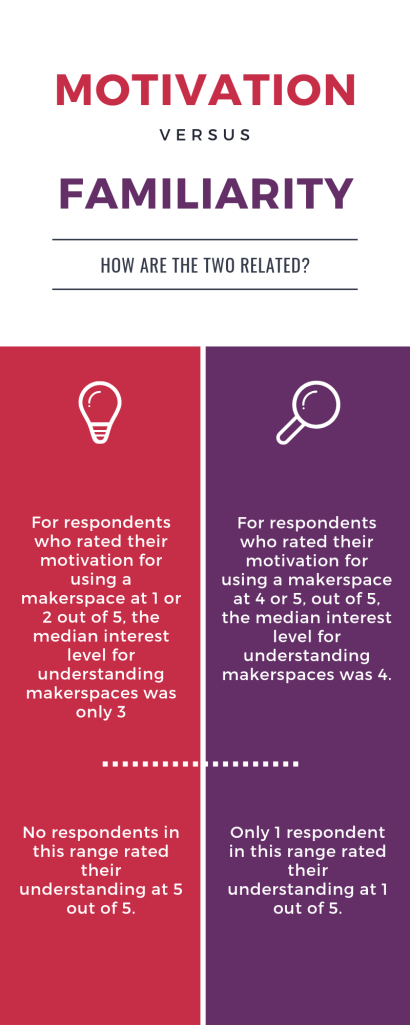
Interestingly, there seems to be a correlation between understanding of what a makerspace is and the motivation to use it. For example, for respondents who rated their motivation at 1 or 2, the median response for understanding was 3. No respondents in this range rated their understanding as 5. For respondents who rated motivation as 4 or 5, the median response for understanding was 4. Only one respondent in this range rated their understanding as 1.
When asked what the most significant obstacle was to using a makerspace for a class, the most common response was “I don’t know what to do with it,” which had 9 responses. The second most common response was, “It doesn’t apply to my discipline.” This response may be another way of saying the teacher isn’t sure what to do with the makerspace. A makerspace can be used for most disciplines. Of course, we need to keep TPACK in mind and make sure we are doing the best activities to help our students learn. Our teachers know what works best for their own class far better than I do. But it seems reasonable that the motivation to use the space could increase if teachers were given more ideas about how to do it. We may find that makerspace activities may be the best way to teach certain concepts.
Our goal is to give students a learning experience that is relevant to them and involves helping the community in some way. We want them to learn more technology and creative problem-solving. We would like them to learn the value of iteration and that it is ok to fail. It is also important for them to learn to collaborate with businesses, and others in the making community to solve problems.
We thought one good way we could give students a high-quality learning experience like this was to connect with an existing makerspace in the area. We found a partner whose philosophy is very much in line with our own and who could offer us all the things we wanted. However, I was surprised to see that only two respondents said they thought that going offsite to gain access to better equipment was a good idea. The main reason for this response had to do with logistics though several people were concerned that the space would not be readily available for all classes.
Expectancy-value theory says that we are motivated to do things that we value and that we expect to succeed at (Brophy, 1999, Brophy, 2010, Wigfield and Eccles, 2000, Wigfield et al., 2008). In other words, we need to educate and inspire our faculty to use the space if it is going to be successful. We should also create a space onsite, so all faculty and students can access it. My thinglink presentation has more details about this problem and a potential plan for addressing it.
REFERENCES
Kale, U. (2018). Technology valued? Observation and review activities to enhance future teachers’ utility value toward technology integration. Computers and Education, 117, 160-174. Retrieved from: https://www-sciencedirect-com.proxy2.cl.msu.edu/science/article/pii/S0360131517302336
 Brian Durst EdTech