
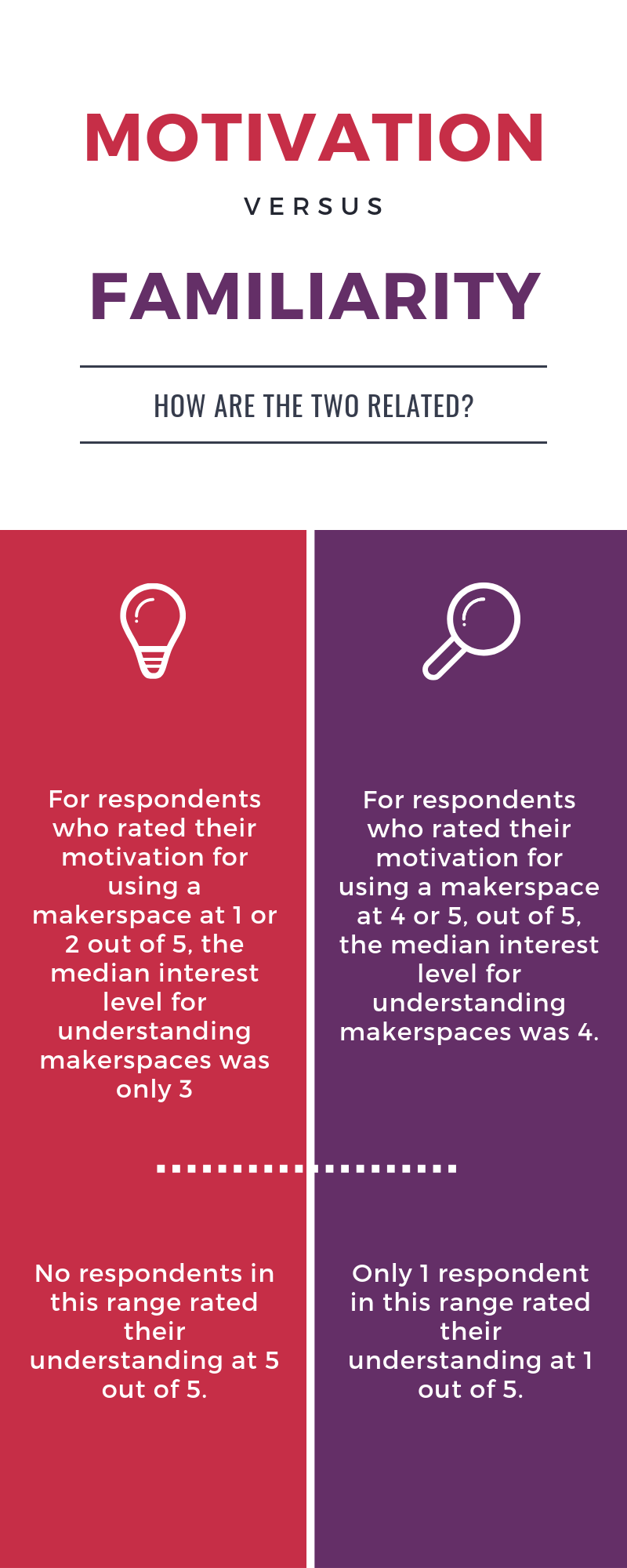
The other big finding from the survey was that there seems to be a correlation between understanding of what a makerspace is and motivation to use it. The higher a respondent rated themselves as understanding what a makerspace is the higher their motivation to want to use one.
This could be just because people who are more motivated will naturally want to learn more about what a makerspace is. However, many of the people who were less motivated cited obstacles such as “I don’t know what to do with it.” This was the most common response to the biggest obstacle to using a makerspace.
The second largest response was, “It doesn’t apply to my discipline.” I have seen excellent examples of makerspace projects for most disciplines. This suggests that teachers may not be aware of all the options available to them. Of course, we need to respect that maker projects must make sense for each individual’s pedagogy and that no one knows that pedagogy better than the teacher. But if we provide examples and inspiration in a variety of disciplines, this perception may change.
According to the expectancy-value theory, our interest in putting an effort into an activity depends mainly on two factors – the value we place on the activity and our expectations of ourselves to be able to complete it successfully (Kale, 2018). In other words, if we do not see the activity to be an important task and if we believe that we lack the necessary skills, then we will not be interested in completing the activity.

REFERENCES
Kale, U. (2018). Technology valued? Observation and review activities to enhance future teachers’ utility value toward technology integration. Computers and Education, 117, 160-174. Retrieved from: https://www-sciencedirect-com.proxy2.cl.msu.edu/science/article/pii/S0360131517302336
 Brian Durst EdTech